The policy dialogue, held alongside the Pacific Innovation Forum for Climate and Environment (PIFCE) conference allowed women to share their lived experiences with ministers from Vanuatu, Kiribati, Tuvalu and Samoa, and call for their inclusion in gender-responsive climate decision-making processes. Ministers and regional leaders reflected directly on what they had heard and discussed what it meant for climate action going forward.
The connection between disaster and violence against women
According to the 2024 National Survey on Women’s Lives and Family Relationships conducted by the Vanuatu Women’s Centre and the Vanuatu Bureau of Statistics, women face increased physical or sexual partner violence during and immediately after a disaster.
In a country where 86% of women experience at least one or more types of intimate partner violence by a husband or partner in their lifetime, coupled with the fact that Vanuatu is one of the most disaster-prone countries in the world, climate shocks are accelerating the violence women face, and therefore, it is critical for women’s voices to shape climate policy.
“Women’s voices are excluded from decision-making spaces,” said Flora Vano, ActionAid Vanuatu Country Manager. “As a result their valuable knowledge and firsthand experiences are not being considered when it comes to climate and disaster policy and programming. We must integrate prevention of violence against women into government climate plans, and we’re calling on Pacific government leaders to take responsibility for this issue.”
Women-led recommendations to reduce violence
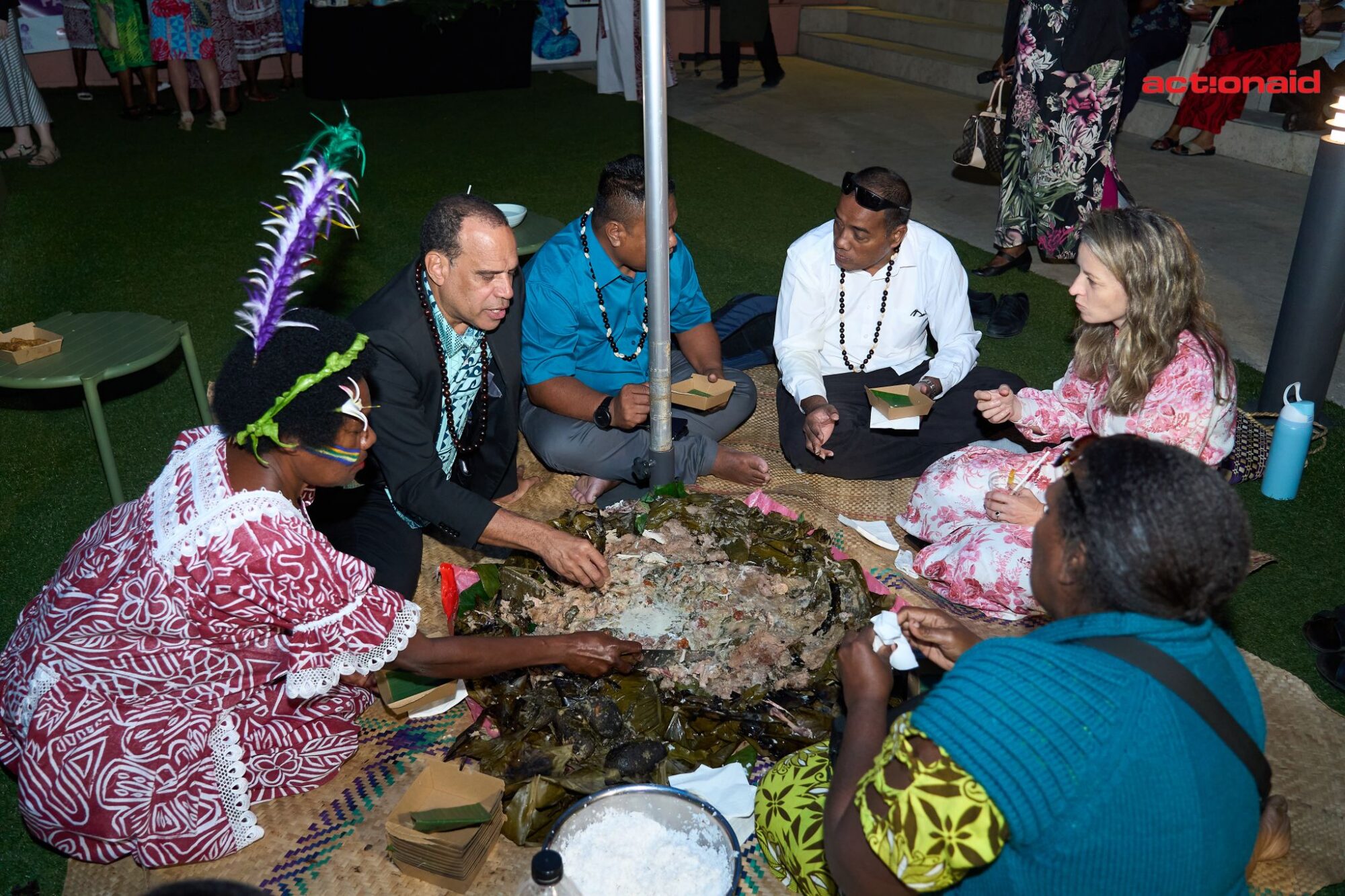
Ni-Vanuatu women shared their experiences with government representatives from across the Pacific region.
The dialogue emphasised that the crisis of violence against women and the climate crisis is one compounding human rights crisis. To address this, the following recommendations were made. The recommendations from the dialogue were presented to Pacific ministers and delegates at PIFCE, and will inform regional advocacy in the lead-up to COP31, where Australia will hold the presidency of negotiations and Pacific voices will be central to the global climate conversation.
- Integrate the prevention of violence against women and girls into climate change adaptation, disaster risk reduction, preparedness, and humanitarian policies and programs, given the increase in violence against women, girls, and women with disabilities during climate emergencies and disasters.
- Call on men in positions of leadership and influence, including Pacific ministers and officials, to take personal responsibility for ending violence against women and to actively model and advocate for change within their own families, communities, and institutions.
- Ensure that diverse women, including rural women, young women, and women with disabilities, are empowered and supported to participate meaningfully in climate and disaster decision-making and design processes from the earliest stages.
- Invest in and resource local women-led movements and leadership as essential actors in gender-responsive disaster preparedness, humanitarian response, and climate adaptation at local, national, and regional levels.
- Ensure women with disabilities lead and participate directly in decisions on climate adaptation, disaster preparedness, evacuation planning, and recovery, given they face compounded discrimination and heightened exposure to risk during crises yet remain persistently excluded from decision-making spaces.
- Strengthen institutional coordination between ministries of climate change and national women’s machineries, ensuring gender and protection expertise is embedded in climate adaptation, disaster risk reduction, and resilience planning from the outset, not only during emergency response.
- Design climate-resilient infrastructure, including roads, evacuation centres, transport, and water systems, with women’s safety and accessibility at the centre, as designs that fail to consider these factors can inadvertently increase protection risks.
- Expand affordable telecommunication, internet, and mobile network coverage to remote communities so women can access early warning systems, emergency information, and support services during disasters. Include strong safeguarding and risk mitigation measures to protect against technology-facilitated violence.
- Invest in renewable energy solutions, including solar lighting and community energy systems, to strengthen resilience, economic empowerment, and women’s safety.
- Prioritise gender-responsive climate financing for women-led, climate resilient initiatives that strengthen community resilience and protection.
- Stakeholders working in climate justice need to create space for local women across the region to learn and support each other in order to influence policy, strengthen collaboration between governments, civil society, and their communities. This will be strategic approach to work towards regional and global advocacy.
The participatory dialogue was convened between Ni-Vanuatu women leaders and Pacific ministers and delegates by ActionAid Vanuatu, the Women I Tok Tok Tugeta network, the Vanuatu Ministry of Climate Change, and UN Women through the Pacific Partnership to End Violence Against Women and Girls (Pacific Partnership) which is funded primarily by the Australian Government, and the European Union.